

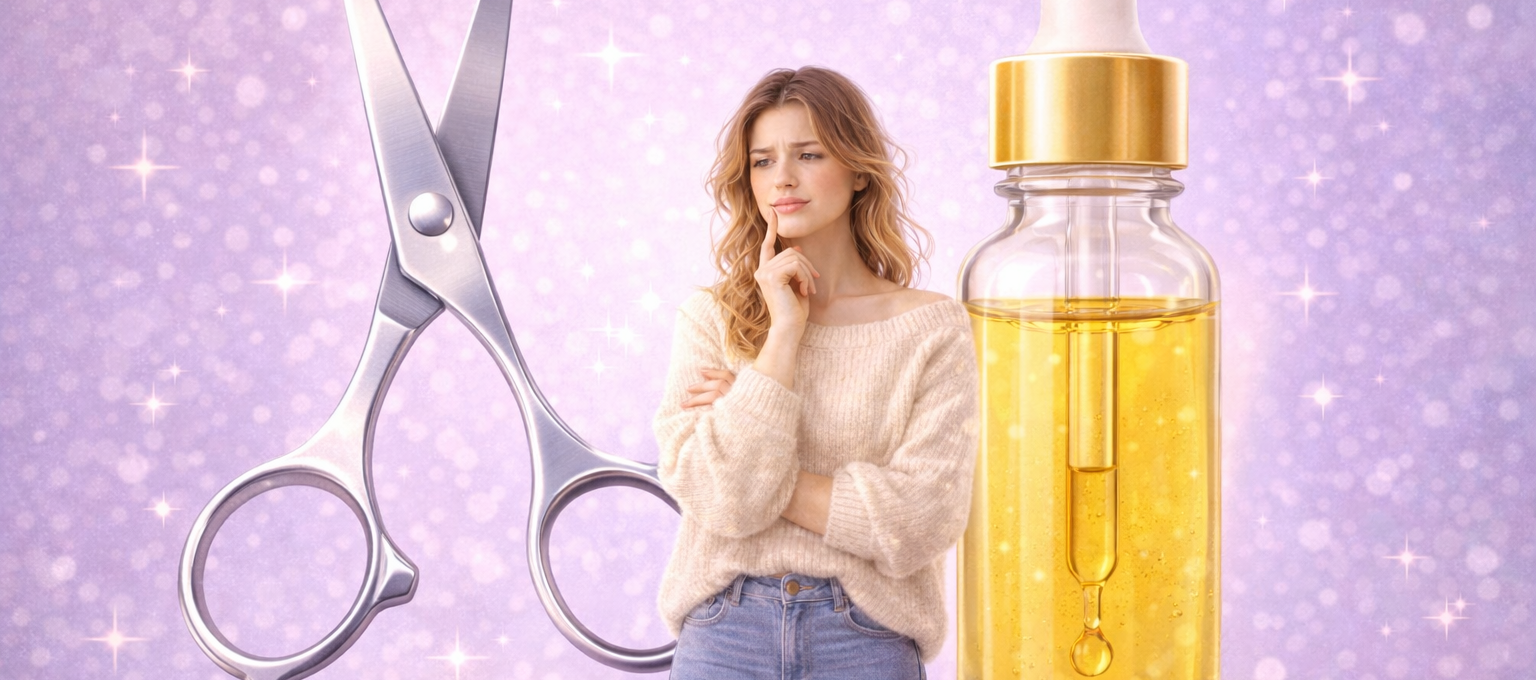
Why do your ends become dry and brittle after winter, and what actually helps you keep your length?
Dry Ends After Winter: How to Save Your Length Without a Drastic Haircut
-
- Updated:
- 0 Comments
After winter, hair often looks like it is just as tired of the cold as you are. The lengths feel drier, the ends tangle more easily, turn frizzy, catch on clothes, and start snapping off. At some point, it can feel like scissors are the only answer.
But it is not always that dramatic. If your hair has become drier and harder to manage, that does not automatically mean you need to say goodbye to your length. The key is to be honest about where good hair care can still help, and where a trim really is the better option.
Why the ends suffer first
The ends are the oldest part of your hair. They have been through the most washing, blow-drying, friction, cold weather, hats, dry indoor air, and daily wear and tear. Very little natural oil from the scalp ever reaches them, which is why they are always more vulnerable than the rest of the hair.
After winter, several factors usually make things worse at once:
- dry indoor air
- cold weather and wind outside
- friction from scarves, collars, and hats
- hot blow-drying
- not enough regular protection on the lengths
As a result, the hair loses moisture, the cuticle becomes damaged, and the ends start to look dry, dull, and untidy.
Dry ends and split ends are not the same thing
This is a very important distinction, because this is where unrealistic expectations usually begin.
Dry ends can still be made softer, more flexible, and better protected.
Split ends cannot be repaired.
Once the hair shaft has split, no mask, oil, or repair serum can truly fuse it back together, no matter what the marketing says. Hair products can only:
- temporarily smooth the surface
- reduce roughness
- make the damage less noticeable visually
But if the end is already split, there is only one real solution: a trim.
When hair care can still help, and when you need scissors
Hair care can genuinely make a difference if:
- the ends are dry but not split
- the hair feels rougher than usual
- you are dealing with frizz and texture
- the lengths tangle, but are not breaking off
A trim is needed if:
- you can see the hair shaft splitting
- the ends look thin, wispy, and fragile
- the hair is breaking along the length
- the dryness does not improve even with good hair care
It is important not to put this off for too long. Split ends do not stay put. They travel upward along the hair shaft and can eventually cost you more length than a timely trim ever would.
How to help dry ends if they are not split yet
The main thing here is not to hunt for one miracle product, but to build a solid system of protection.
1. Use conditioner after every wash
This is not an optional step for days when you have time. It is a basic part of hair care. Conditioner helps smooth the cuticle, reduce friction, and make hair more flexible.
If your ends are dry, conditioner should be part of every wash day, except on the days when you are using a mask instead.
2. Use a hair mask, but keep your expectations realistic
A hair mask will not repair an already split end, but it can do a lot for dryness, especially if it contains:
- emollients
- lipids
- amino acids
- hydrolyzed proteins
It helps fill in weak spots in the hair fiber, making the lengths smoother and reducing the risk of further breakage. But it is important not to expect it to “repair” hair that is already mechanically damaged.
3. Leave-in care is what really helps save your length
Honestly, leave-in products are often what determine the fate of your ends in everyday life. A cream, fluid, or serum creates a thin protective layer that:
- reduces friction
- helps retain moisture
- makes the ends less vulnerable to dry air and rubbing
And yes, this is not treatment. It is protection, prevention, and a way to reduce breakage.
4. Less hot air means a better chance of keeping hair soft
Even if you do not use a curling iron or straightener, regular blow-drying still matters. Hot air dries out the lengths very quickly, especially when the ends are already weakened.
It is best to:
- dry your hair on a warm or cool setting
- keep the blow dryer about 30 cm away from your hair
- avoid overdrying the ends
- use a heat protectant
5. Hair oils for the ends are helpful, but they are not an emergency fix
Hair oils do not hydrate the hair, and they do not repair split ends. But they can:
- soften the ends
- reduce roughness
- add visual shine
- slightly reduce friction
So they are a good supporting step for prevention, but not a replacement for conditioner, a mask, or a trim.
6. A trim is not the enemy of long hair
This is the part nobody really wants to hear, but it is better to be honest: if your ends are already split, no product will restore them. Sometimes trimming off a few centimeters is exactly what helps your hair look fuller, healthier, and neater overall.
That is not “losing length.” It is preventing the damage from traveling further up.
What usually makes the ends worse
There are a few habits that make dryness and breakage come back very quickly:
- skipping conditioner
- constant friction against clothing
- blow-drying with hot air
- overusing heated styling tools
- forcefully brushing dry, tangled hair
- avoiding trims when the ends are already split
What actually works
In simple terms, the approach is this:
- cut off anything that is already split
- restore what is still dry but intact
- protect everything that grows from this point on so it does not end up in the same condition again
This is where real length care begins. Not with promises to “seal split ends,” but with understanding where the hair can still be supported and where it is better not to waste time on illusions.
So, what is the takeaway?
Dry ends after winter are incredibly common. But they do not always mean you need a blunt bob. If your lengths have simply become drier, they can often be helped with conditioner, a richer mask, leave-in care, and a gentler daily routine.
But if the ends are already split, it is better not to promise yourself miracles. Split ends do not seal themselves back together. They need to be trimmed. And the sooner you do it, the easier it will be to keep your hair looking healthy and beautiful going forward.

Leave a Comment